
BY: Alisha Gonzales
[SFX: Music]
Imagine you’re hungry. Really hungry. The kind of hungry where toast sounds like heaven. You open the fridge.
[SFX: Fridge door creaks open]
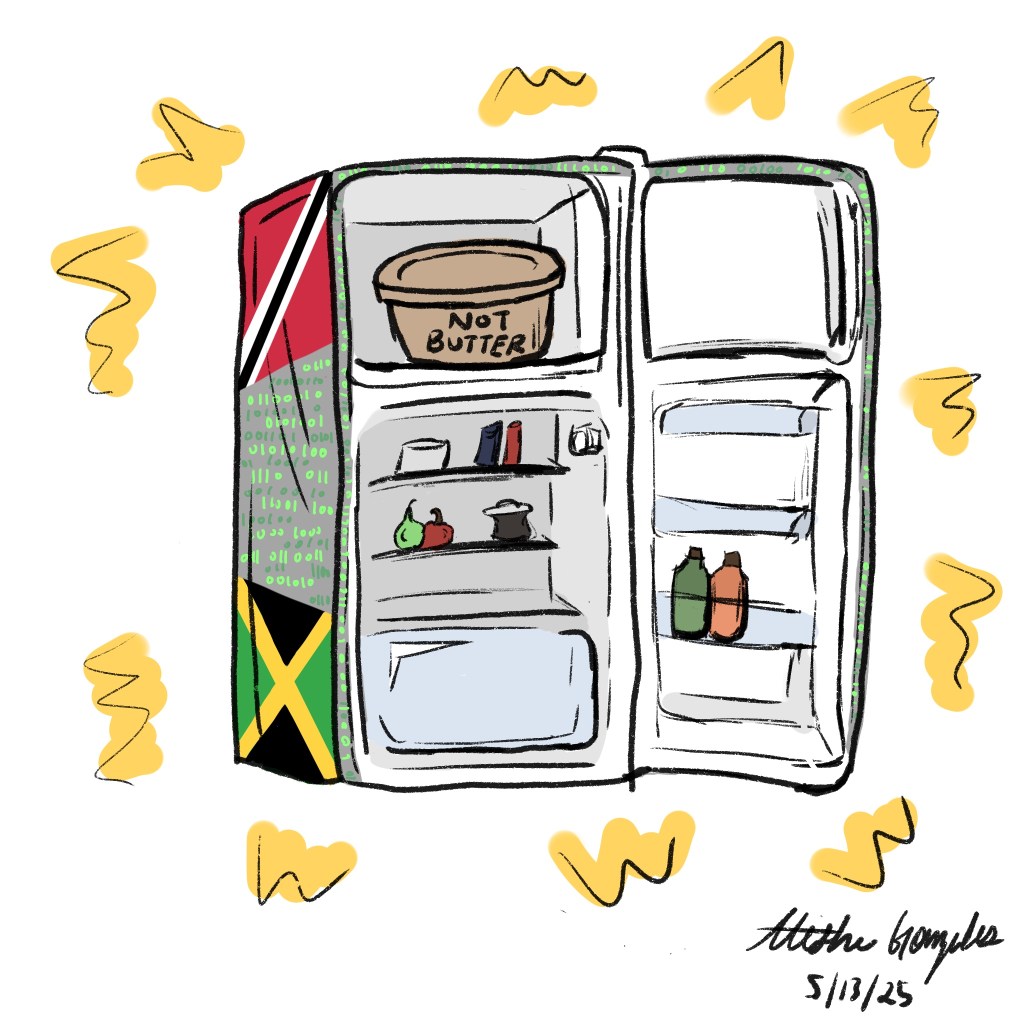
There it is: that familiar tan Country Crock tub. You smile. Butter secured.
You open it…
[SFX: Lid opens. Music stops. Then sad violin music]
Rice. And red kidney beans.
It feels like a scam. But I’d argue it’s something else: it’s Caribbean design.
[SFX: Music fades in]
I grew up in a Trinidadian and Jamaican household, where the fridge was always packed and chaotic. If you opened a reused tub, odds are it held rice and beans, curry goat, stew chicken, or spaghetti with meat sauce, which isn’t necessarily Caribbean, but it commonly lives in our fridge anyway. Sometimes it’s green seasoning, that quintessential blend of herbs in Trinidadian cuisine, and somehow still has no official name. The point is: what’s inside matters less than the fact that you know what’s inside, even before you open it.
[SFX: Music fades out]
In this piece, I want to explore the reuse of butter tubs and other containers in Caribbean households as a form of everyday hacking. These objects reflect alternative knowledge systems, resist capitalist waste culture and planned obsolescence, and showcase resourcefulness, wit, and generational memory.
First: What even is a hack? And what is “the South”? Hacking is usually imagined as digital: code, computers, Silicon Valley. But as Beltrán mentions in “Code Work,” hacking can also happen in domestic spaces. Everyday people, often women, innovate quietly within the home. The reused butter tub is a perfect example: it’s household code passed down through generations. Hacking, in the Global South, often looks like making do and making it last.
I asked my mom to explain why she saves containers, and all she said was: “What else do you want me to put the leftovers in?”
And she’s right. The logic is simple. Why throw away a perfectly good container?
Using that tub isn’t just practical. It’s a refusal, a quiet resistance against capitalist expectations that we use things once, toss them, and buy more. It rejects planned obsolescence. And sure, you could buy clear matching Tupperware to impress your guests, but not everyone has the luxury of aestheticism. For many, function comes first.
And honestly? The butter tub might not even be yours. It might’ve come from your aunt, full of pelau and coconut bake. These containers travel. They’re shared. They carry more than meals. They carry memory.
This is where Meneses comes in. In “Tastes, Aromas, and Knowledges,” she reminds us that knowledge is embodied. It lives in the senses. I don’t have to open the tub to know what’s inside. I can tell from the weight. The feel of the lid. The way the contents shift inside. That knowing lives in my body. It’s not written down, but it’s passed down.
That’s knowledge, too.
The scent of curry, the hint of stew wafting through the cold air, the way green seasoning clings to the plastic, it all tells you what’s inside. You don’t need to see it. Your body already knows.
But not everyone sees it that way. Some people see reused containers and think: cheap. Poor. And yet, someone else does the same thing and gets labeled eco-friendly, sustainable, a genius on TikTok.
Jenna Burrell, in her work on Ghanaian internet users, talks about how their digital improvisation was often read only as scamming, and to be fair, a lot of them were scamming. But that doesn’t mean they weren’t also innovating. They were working around systems never meant for them, systems that excluded them economically and digitally. In a way, my fridge does the same. What looks like chaos or confusion is actually intelligent adaptation. A different kind of hack.
This isn’t just Caribbean. Versions of this practice exist across the Global South, among working-class and immigrant families everywhere. But the Caribbean fridge holds a specific cultural logic: to me, it’s layered with family, humor, sharing, and survival. It doesn’t need to be respectable. It just needs to work.
[SFX: Music fades in.]
What looks like trash, or poverty, or a scam, might actually be a whole system of knowledge, one built on skill, memory, and quiet resistance.
This isn’t just a reused butter tub. It’s a design system. A relational practice.
It lives in the South. In our homes. In our hands. Throughout generations.
[SFX: Music swells, then fades out.]
Readings:
Meneses, Maria Paula. “Tastes, Aromas, and Knowledges: Challenges to a Dominant Epistemology.” In Knowledges Born in the Struggle, pp. 162-180.
Beltrán, Hector. “Code Work: Hacking Across the U.S./México Techno-Borderlands.”
Burrell, Jenna. 2012. “Ghanaians Online and the Innovation of 419 scams.” In Invisible Users: Youth in the Internet Cafes of Urban Ghana, pp. 55-79. Cambridge: MIT Press.
Escobar, Arturo. “Thinking-feeling with the Earth: Territorial Struggles and the Ontological Dimension of the Epistemologies of the South.” In Knowledges Born in the Struggle, pp. 41-57.
Löwy, Michael. “Ecosocialism” Pluriverse: A Post-Development Dictionary, edited by Ashish Kothari, Ariel Salleh, Arturo Escobar, Federico Demaria, and Alberto Acosta,
Image Credit
Alisha Gonzales 5/13/25

