
BY: Kristen Si
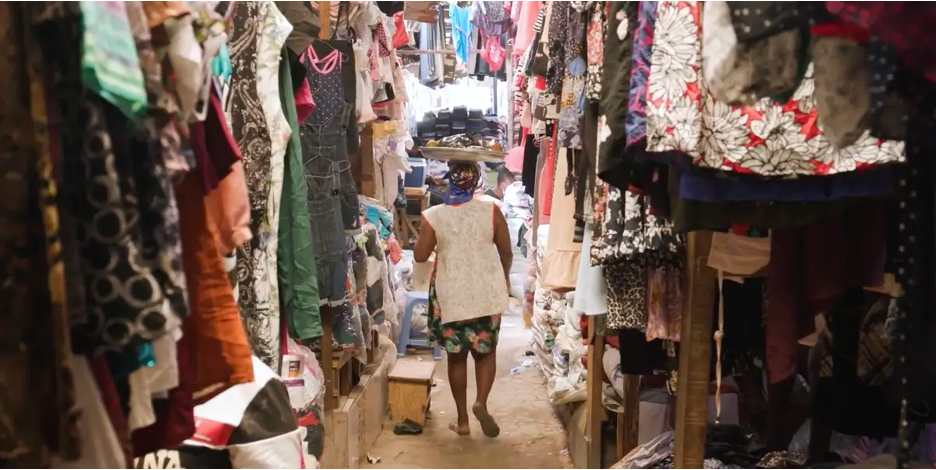
Along the Volta River, the environmental destruction of the global fashion industry cannot be ignored. The shores are suffocated under mountains of tattered fabric, an imprint of waste colonialism onto the landscape of Ghana.1 Just an hour’s drive away lies Kantamanto Market, Africa’s largest second-hand clothing market. The streets are littered with obroni wawu, an Akan phrase meaning “dead white man’s clothes” implying that for a person to give up so much clothing, they must have died.2 Every week, more than 15 million clothing items are imported here, with around 40% of these items being dumped into overflowing landfills nearby.3 Much of the clothing is poor in quality in large part due to the rise of the fast fashion industry or is simply not appropriate for the hot climate in Ghana.
Scenes like the one in Kantamanto Market are found across Africa, creating environmentally destructive, often unprofitable economies from the waste of the Global North. In Rwanda, former Minister of East African Community Affairs, Valentine Rugwabiza, pushes for resistance against dependence on imported clothing, emphasizing a need to reclaim agaciro, which under one translation means dignity.7 So, how can Ghanaians reclaim the ideals of agaciro in resistance to waste colonialism?
For entrepreneurs Yayra Agbofah and Kwamena Dadzie Boison, co-founders of the startup brand THE REVIVAL, the answer lies in upcycling. Upcycling aims to take low-quality or unsuitable materials and remake them into usable products. Agbofah and Boison work with local craftsmen to create fashionable products from clothes at Kantamanto Market. In particular, Boison notes that THE REVIVAL “takes the things that have the highest tendency of ending up on a landfill” to maximize waste reduction.*
Anthropologist Gabriella Coleman defines hacking as where “craft and craftiness” converge. Agbofah and Boison demonstrate how these aesthetics of hacking can be applied to sustainable fashion.6 Using only low-quality materials from fast fashion, Agbofah and Boison’s products not only demonstrate great technical ability in sewing and design but also creative and durable styles used by pineapple farm workers and shoppers of the Victoria and Albert Museum in London alike.4
THE REVIVAL challenges sustainable fashion branding in the Global North, noting that sustainable fashion has been subject to “greenwashing” or the projection of brands as sustainable through marketing while the brand still participates in wasteful processes. THE REVIVAL poses an alternative form of sustainable fashion, one with “thoughtfulness about how things are done with the earth, putting nature in mind”.* In doing so, Agbofah and Boison aim to form a sustainable revolution based on mutual respect between consumers and the Earth – a recentering of agaciro in the fashion industry.4 THE REVIVAL forms communities around these ideas of sustainability, providing a course to others on creating sustainable economies through upcycling.
Ghanaian-based designer, artist, and entrepreneur Sel Kofiga draws upon similar ideas of sustainable fashion in his upcycled clothing brand, The Slum Studio. Kofiga focuses on making unique hand-painted garments made from materials he finds at Kantamanto Market. Kofiga notably focuses on representing the stories and experiences of everyday Ghanians at Kantamanto Market through his designs, utilizing bright colors and symbols that draw upon photos and conversations he has had with others at the market.** He notes his work comes from a place of resistance, showcasing that people in Kantamanto have to “use their creativity and imaginative skill to turn all these used materials into something new, fighting against a system that they didn’t create” through his art.**
In particular, Kofiga draws inspiration from Fugu, a traditional handwoven garment that is handed down from generation to generation. In passing down these garments within a family, the fabric becomes imbued with memories and meaning, drawing a relationship between the wearer and the material. Kofiga notes that Fugu is stored through times of disrepair until a tailor can repair the garment. As a result of the connection between the people and the material, the Fugu prevents environmental waste as a result of fashion. Kofiga places connection above production in his work with The Slum Studio, noting he wants “to give the consumer a new way of thinking about waste material [as you] are wearing a piece of art and the only option you have is to take care of it.”5 In drawing from these ideas, Kofiga places uniquely Ghanaian sustainability ideals at the forefront of his work.
THE REVIVAL and The Slum Studio are only two of several upstart brands based in Accra, Ghana focused on the idea of upcycling waste and forming sustainable economies. These brands demonstrate resistance against the imposition of waste on their local environment by the Global North, pose alternative forms of sustainability within fashion as a direct response to fast fashion, and demonstrate reclamation of the ideals of agaciro in the second-hand fashion industry.
Further Reading:
- https://livingwaterswim.org/expedition/
- https://www.google.com/books/edition/Wasteland/w3yaEAAAQBAJ?hl=en&gbpv=0
- https://etd.ohiolink.edu/acprod/odb_etd/etd/r/1501/10?clear=10&p10_accession_num=ucin1553613566277155
- https://www.therevival.earth/
- https://www.friendsoffriends.com/profiles/accra-sel-kofiga-artist/
- https://www.jstor.org/stable/j.ctt1r2gbj.9
- https://cup.columbia.edu/book/pluriverse/9788193732984
Interview Audio:
*https://www.youtube.com/watch?v=axEj0L0pcOw
**https://www3.nhk.or.jp/nhkworld/en/ondemand/video/2058999/
Other Audio Clips
Kantamanto Market Audio Clip: https://www.youtube.com/watch?v=dTc5HwNd3s0
Matutu Mirika: https://www.youtube.com/watch?v=vkshbGNk66Y
Waves Audio Clip: https://www.youtube.com/watch?v=vQNVDbgwZvE
Image Credit

